

Persian names trend; Pan-Persian tendency. A society ready for a revolution; or a historical tantrum?

Note: The names of Iranian people, of places on relation to people, are not mentioned for the safeguarding of them.
During our time in Iran I abstained myself from keeping an online or digital written diary. After we were once stopped by the Iranian Sepah for taking photos of something which we did not know was forbidden, I deleted many photos which did not have any touristic relevance. I simply felt that nothing could be ascertained as to what they categorize as “sensitive”, illegal or offensive. We preferred to be cautious, but the feeling that we could often be perceived as “enemies” (while being simply tourists) was strong. Perhaps it was because during that time a British couple were arrested under the charges of spying, although they were systematically interviewing people; collecting the information and sending it to some academic institutions (too much).
1. A curious trend has been developing in Iran:
To name children with Persian names. Being the main characteristic for them: the ending with “a”.
Parsa; Kiana; Arya; Atoosa; Pouya, etc.
This trend not only has an affirmative force: assert an identity; but an equally negative one too: not to name them with Arabic names. And it is, actually, difficult to determine which of the forces is the original impulse/motive/intention: if affirming an identity or rejecting something (a century long conflict, some scholars might argue). But it certainly carries a good load of both today.
Nevertheless, one thing is certain: it is not a trend about names as in many other societies nowadays, it is a manifestation of a vaster social sentiment and idiosyncrasy which runs deep into Iranians’ mind-set and existential view. Nourished with historical ideas and concepts of an eternal “grandiose past“; a past located in various points in history (mostly 50 yrs ago; rarely the Qajar; sometimes the Safavid,…. ) but always in the past. But a past somehow imagined and tainted with modern realities (mostly western ones) producing a variety of theories, stories, wishful thinking and desired scenarios (of / for them) which touch the imaginary, reflecting an element of seclusion and isolation. A very dangerous state, indeed, where any sort of manipulative force can easily misguide them, (wondering if this stranded-in-the-past syndrome was not the cause which brought Iranians into the present situation, which they so deeply despise). For under such blurred and illusory vision of the world, exacerbated by the isolationist state of the country and fed sometimes from abroad by Iranian social media groups and influencers living in Western countries (some of them funded the West), it is not yet clear what is what they want; only what they do not want and wish to be rid of. The overwhelming and dominant sentiment is simply one: rebellion and anti – …”many thing” attitude: including and embedded in the Persian names trend (in its negative element,as explained above). Reason why, this trend is not as any other “name trend” in any another society.
Exactly, such a trend is also an expression of rebellion, protest and rejection. But also of affirmation: of an identity. Affirming through what “something it is-not ? (it seems more a definition and knowledge of “the other”, but not of one’s self); An eternal argument between cause and effect; of past and present, of discontent and contentment:…………. of conflict). Mixed with current problems, as it is the hard economic situation in Iran at the moment, above all their excessive, almost surreal inflation (1 euro – 80,000 rials we arrived; up to 93,000 in a couple of weeks); unemployment and sub employment: PHD, university professors working as Snapp drivers (Uber in the rest of the world) after work, for making-up for purchase power. And so, what can be sensed in Iran is a sort of:
Pan-Persian sentiment (hollowed)
Hollowed, not only because its force is generated from that negative attitude (supra), which defines more what they do not want to be; but because when on hearing the aspirations and ideals composing such a sentiment, it transpires to be mainly composed by a Western way of life as an ideal, rather than a “Persian” ideal based on some grand past filled with abundance of life and plentiful of “freedom” under Persian values, notions and ideologies. Temporarily and ideologically, it is not clear at all, as this Pan-Persian sentiment they express is devoid of an intellectual framework and historical coherence; located in many periods in Iranian long history, but somehow contains more a Pahlavi daydreaming. Its symbolism does not portray a Zoroastrian, Samanid, Safavid or any other Iranian emulations but it seems it is mostly the Iran of 1970’s; The Shah, etc. (who in fact they themselves overthrew. Not even a Western orchestrated revolution).
- There is the photo of our handsome king and queen” (Young Iranian, at an antique shop in Gorgon)
The plates were definitely not on display, the shop’s owner brought them from the inside of the shop. I preferred to delete the photos of these plates for the reasons I explained above.
I thought to ask her if he had not actually been overthrown by the people themselves, but after already several weeks in Iran, I knew such discussions do not pass a couple of years in time and a narrow reason, so
A Hollowed Sentiment

A hollowed feeling not only in its lack of any intellectual and historical coherence, but because it is vastly fed by Youtubers, Instagrammers and Facebook accounts (oft-times from Iranians overseas, apparently), and which appear to appeal, most of all, to their bitter discontent of the current situation; discontent in which many young Iranians have found a collective identity, predominantly marked and led by sheer rebellion, but devoid of any sort of creative or generative force which could at least produce some constructive ideal of Persian identity or life, and not only anti-religion; anti-parents…………, anti-ethnic feelings.
Anti-Arabic sentiment.
- Can you make this sound…. [ɲ] ?
- Come on!…… Come on! do this sound… [ʎ] ?
- What about this ………[ɡ]?
- (mockingly laughing as if of a ghost)
I was wondering what they were amusing themselves so much of, as they were so exalted, and at the same time abstracted from that moment, because every single sound they mentioned exists in the Romance languages: French, Portuguese, Romanian, Italian and most of all in Spanish with its LL, Ñ, Y, and consonants with double phonemes as the “G”. But then they clarified their mockery saying:
- “Arabs cannot pronounce this sounds of Farsi !
At a personal level, the moment astonished me in its seclusive element. Something which I have only seen during my volunteering time in remote communities hit by extreme poverty. But with the abysmal difference that those poor, remote areas do not have such a resentment as the emotional load of their mockeries, but simply the fact that they have never seen, nor heard something before. That is the difference between a physical involuntary isolation, belonging more to populations being left forgotten; and the isolation as a product of political or ideological causes: a chosen isolation of the mind, for Iranians are not completely isolated. They are very well connected to worldwide social media platforms (unlike China); most of all, Instagram, Youtube and Facebook. To choose to connect only to Farsi sources, and in particular to Farsi sources which feed their discontent, racism and closed imaginary identity it is something worse than poverty of the mind. And it actually reflects more a fanatic religious tendency (of which they want to get rid, but it seems they are part of), rather than a real Persian tendency. For any good academic could confirm you the relative good openness and tolerance of the old Persian empires; most of all the Achaemenids. Something which surely their social media “influencers” might not instruct them about. Because as any intelligent person of the year 2025 knows: many of those influencers are nothing but cheap pamphleteers paid by governments, NGOs, etc.
Actually, as someone who lived in Hong Kong during the 2014 and 2019 social movements/protests. I saw many common elements with the Hong Kong protesters, as for example: the hatred that young Chinese Hong Kongers felt often times for the Chinese ethnicity itself, of which they essentially are. As the cheap ideology of NGOs, influencers and social media fabrications stir everything together to the level of stupor, the degrading ideological element gets blended with the ethical, and so it was impossible to distinguish what was what. Ultimately their own way of carrying out the social movement itself was a Chinese way; resembling more the Chinese history of Chinese punishing Chinese, rather than a genuine democratic or freedom movement.
And so the way how Iranians articulate this sort of “Persian” or Pan-Persian sentiment and identity, through rejecting not only their particular religious way, government and social situation (which they actually chose), but which they also extended to a more general anti-Arabic element, which goes until the ethnic appealing, seems more inscribed into a conceptual mental scheme of Shi’a Vs Sunni conflict, rather than an effort of reconstructing a Persian image and identity, by which all elements they identify and envision are mostly with a Western way of life and racially Caucasian-looking.
- “We Persians are more Western, as Iran means the land of the Aryans” (repeatedly we heard this).

It was unbelievable to see the degree of stubbornness regarding the racial conception of Iran and the region, what actually borders, if not already dwells, on the provincial and the isolationist of the mind . Because:
I never understood if they had always thought that I was from Iran or Arab; or if they stubbornly and desperately wanted me to be from Iran or Arab.
The degree of surprise, and many times, the indignation they felt when I approached them in English, as if I were teasing or mocking them. Even when I told them I am not from Iran; I am not from the Region; many people would be nonplussed:
“but you have all the Arabic features !”
- All men in my home town look like you: you are from here ! (it made me laugh this comment)
- Maybe all men from your hometown are from country? said I
IT CAN EVEN TURN INTO HARASSMENT: At the Zoroastrian temple, in Yazd city, a tourist guide, who talked to me in Farsi, offering us his services, and to whom I answered in English “No thank you”, kept following me shouting in Farsi until we reached the counter at the entrance of the temple where, when I was paying the entrance fee, he shouted “country, country?”, to what I answered shouting at him back: “you are the one looking from my country, you must speak my language!”.
It was quite funny, actually, when I started speaking French, Italian or Spanish (what I chose to use in the moment) to people who seemed to know where I was from, for they seemed to have been, a-priori (without real proof), existentially sure about where I was from. I continued speaking and asking things in those languages just to see the extend of that chosen isolation.
- And so at Tehran metro station while walking on the platform a man stopped me and asked “country, country” ?
- The worse was at Persepolis: walking around the columns admiring and sensing the depth of history in that place, a man with a black Kefi stopped me with his hand asking me: where are you from, which country are you from ? After exchanging information he demanded a photo of me with my wife, together. When he bade farewell he added: “your behavior says a lot !”
Yes ! Also that old practice of “checking on the behavior of people”; what includes that eternal conflict of wearing of not wearing the scarf /hijab/,etc. among others. So I knew that 1) the combination of what they blindly think as “Arab racial features”, and 2) the unfamiliar behavioral patterns caused a baffling image which it was difficult for them to enclose it in any familiar collective prototype. Not individual prototype, but a collective one. Individualism, by what we have seen already, and by what can be deduced from trends and cultural tendencies is something in lesser degree conceived (but they think themselves as more Westerners, Individualists)
And conceivably: many Spaniards, Portuguese, French, Italians, South Americans (and many others around the world) could be taken as Arabs in Iran and faced with attitudes, not from the fact of being westerners or foreigners (xenophobe), but from having the appearance of what Iranians so convincingly define as Arab racial features. And actually it is the strong rejection and despise of that an imaginary Arabic ghost which drives Iranians to adopt such:
an absurd and foolish attitude in front of a world which is, if not predominantly, largely mixed already. Revealing the extent of their voluntary seclusion and narrowness of mind in which they choose to live in, in order to sustain an illusory fantasy, largely the product of a non-acceptance of certain historical realities (or of their own responsibility, perhaps) about the course of events and about the product of actions based on such denial.
As our guide in Yazd said: “But Persian people were tired of the Zoroastrians too, when Islam came). And so did many Persian generals defected to the Muslim forces, helping them building siege machines and passing other technologies as well as information.
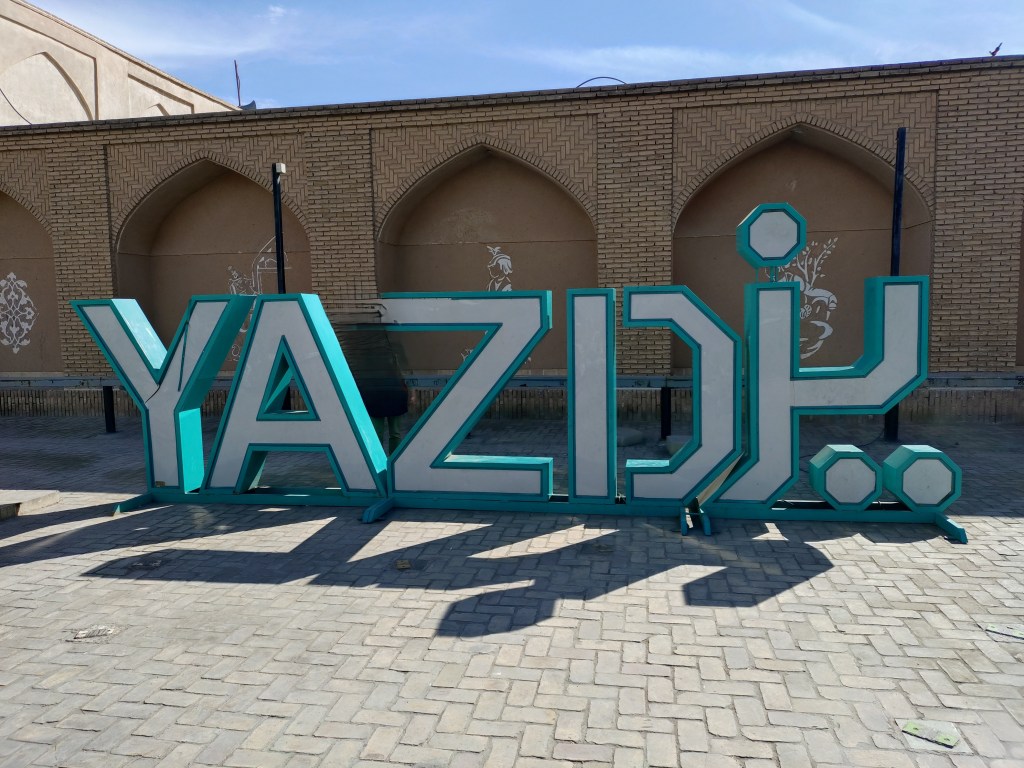
- How can you know how Persians looked like before the Arab conquest ? (I dared ask our tourist guide in Yazd )
- It is almost impossible to know, he rightfully asserted.
- You also said that the celebration of the Nowruz (نوروز) is more legitimate in Azerbaijan than in Iran itself because they party, drink, etc. But do you think that Iranian young people identify that “real celebration” more with a Western lifestyle: getting drunk, drugged and party life, rather than an original Persian way of celebration? (I asked him, while approaching Alexander’s Prison)
- A mix, he said. Because it is almost impossible to know how they really celebrated Nowruz and the young people look too much to the West.
Needless to mention, at many of those “Modern” hostels in Tehran which are catered by young, modern Iranians who reject religion; religious impositions; the use of headscarf, etc. they manifestly have a different attitude in their service for the guests who have an Arabic look, not to say the deep despise for black people (there was a black rapper where we stayed at). And a reverent admiration for any Caucasian-looking people, who were actually the great minority at the moment we were traveling there.
But unfortunately, their apparent identification with the West somehow does not include the attitude towards work, neither the organizational skills; nor the seek for efficiency in their productive activity; as smoking everywhere possible (and as if infringing the law the better), seems to occupy the first line of existential thought in them. A complete lack of order in civility and an appalling service to clients which does not yet have turns and numbers: anyone can pass at any moment; and from managers to clerks abandoning their customer in front of them for chatting with another client or for overseeing personal things or even scrolling their mobile phones. Tutors bringing their child to class, feeding them, helping them with homework whilst delivering classes to clients (who are paying, actually). A working culture which seems to have got stuck decades behind. And which, even if Iran were opened to the world, as how young Iranians wish, to catch-up with the rest of the developed world would cost them a monumental, generational effort. For even if out of spite, disillusion and resignation, they have slowly become slow, lazy, carefree and unconcerned, the habit is already acquired and by now it is deeply ingrained. This working culture as well as many internal tendencies, as the Persian identity in Iran, get exacerbated by the isolation from the rest of the world; making it more difficult to re-integrate them into the world. Conceivably, after a while they will again find another phantasmagorical identity rooted in a remote unconstructable past, and burst again into another revolution and………..(again and again).
Nevertheless, their looking westward as not only a matter of extracting some sort grandeur; in the present, but about the past, goes beyond the emulation to whatever kind of “Aryanism”, but until the point that the majority if not all young Iranians want to leave Iran and go to the West, ASAP. Even if cheated by fake agencies on social media. It was simply astoundingly shocking to see that twelve out twelve students in an English class we were invited to in Tabriz, were studying English with the sole purpose of leaving Iran:
- Teacher: To our foreign invites (us): could you please ask some questions to our students ?
- Why do you want to learn English, said I ?
- To have an opportunity out of Iran
- For joining my parents in Australia, hopefully soon.
- For searching a job out of Iran.
- etc, etc.
- (That was including our friend who invited us to the class: who told us, quote “I want to go to a powerful country”)
But none of the young people we encountered with and had the opportunity to talk with, envisioned to have a try in any of the Gulf countries.
But as one passes time in Iran, elements and things start settling in one’s mind, and one wonders if the anti-Arab sentiment as core element of that Pan-Persian sentiment is nothing but envy: for the majority of the Gulf countries are globally doing well; with world-class services. Even displaying Persian exhibitions in their museums, as one can beautifully appreciate in Qatar’s National Museum: Almost an entire room dedicated to the Shahnameh, something which our Iranian friends did not take it with the same deal of enthusiasm when we told them about it.
Besides that, and in relation to that eternal Iranian problem of the hijab/headscarf, one must say that the historical fact that Iranian males abandoned their own traditional clothes, exacerbates even more the conflict of the hijab. No single Iranian man uses any sort of traditional Iranian clothes. Arabic men they proudly do so.

More and more it appears that that Pan-Persian identity based on rejecting what they think is not Persian and most of all Arabic elements, is enclosed, or perhaps expressed, through a scheme more based on Shi’a Vs Sunni category, rather than affirming any sort of “Persian” reality or identity, and of which young Iranians are in a logic line part of, for centuries (even if denied), for the attitude of non-acceptance of historical realities and of own volition (based on said attitude) and which ultimately turns against themselves (their current order was installed by them in 1979), seem to be closer to an attitude which would not accept, for centuries, certain successions; certain falls; certain conquests; leaving the mind and the soul stuck in a lagoon of still waters and nostalgia, inevitably turning bitter and resentful; finding meaning then in sacrifices and death. But incapable to run as the rest of water is around. Always traveling around the same cyclical shore. Today, the most discernible force (to the educated and experienced eye) is that of rebellion. Not particularly a creative and generative force; but rather a reactionary one. And, plausibly talking: it is not that rebellion could not lead somewhere (as everything always lead to something or somewhere), but in this instance it does not lead to any solid affirmation of Persian identity, neither to the construction of it. As rejection does not necessarily implies creation.
Simply put, rebellion seems to be that of eternal discontent; and even perhaps it is how they should see their own social movement in 1979. But how can they conciliate that Rebellion against what they now in 2025 young Iranians portrait as their golden times ? What they so fervently brought down is what they now daydream as the pinnacle of their modern times ?
Exactly, because that feeling of rebellion (which is also included in the Persian names trend) is not the product of a virile struggle valiantly fighting against an oppressive regime ……………..(Marvel stupid sort of narrative), but rather:
a general, existential crisis against history, norms, parents……………….
And which seemingly seeks more a secret punishing of their “ogres”, in doing all contrary things which they have been told not to do, rather than to seek and “feel freedom”. A kind of existential tantrum ( wondering if that sick habit of smoking every five minutes and in every possible place, position, form, etc, also is an expression of that tantrum).
Sheer rebellion and Tantrum
Rebellion. We grew tired of being a sort of: “excuse” for young Iranians whom we met and invited us to their homes, for it seemed that our visit and presence provided them with an excuse for doing things which parents did not approve of. The great “hospitality” and utmost care shown to their foreign friends always had a concealed, hidden personal interest. Not about “visiting the museum or national park with my foreign visitors”, but about going and picking up my girlfriend (of whom my parents do not approve of, because she is of an ethnic minority, non-Persian) during working hours, and spend the whole day with her. Using us as an excuse. And so were those noble invitations to stay at some well-off young Iranian’s homes, and who have had the great opportunity to travel around the world in these years of otherwise hardship for the majority of Iranians: first, a kind invitation to foreign “friends” (us), as part of their hospitality, whilst concealing the real calculated movement that their parents were not at home, so it was the perfect opportunity to invite all their friends for “feeling free”. Parents would not refuse “foreign friend coming for a visit”.
But it felt that it was rather a desperate attempt to “show-off” some “free life” (Western type): through getting drunk and ingesting drugs. Because indeed, “showing-off”, is what ultimately could be felt in the ambiance rather than a moment of genuine fun and divertissement among friends. Unfortunately for them we loath such “parties”; and fortunately for us, there are always Snapp (Uber) drivers in Iran at all times. For freedom is not a desperate tantrum expressing rebellion (what express the bitter yoke which they still feel), and besides that conversations about “western friends and western stories” is not something we were very keen to hear when traveling in Iran, as we do not need any western appealing or western acceptance. What actually reveals is not only their submission to western things and people, but a certain shame they feel in front of the west.
And certainly, connecting together elements from the praxis, on the ground, socializing and interacting, to the idiosyncratic and the imaginary, the desperate need for rebellion seemed to be not the product of a particular regime, status quo, etc, but rather more general, complex and with long ramifications into the past and present.
And as long as they remain trapped in that illusory “Persian” fantasy, they would not see that their current rebellion is nothing new and dangerously doomed to provoke the same past results. Because as stated supra: said Pan-Persian sentiment, hollowed in its contents and merely a rebellious rejection of everything they do not consider “Persian” (which they cannot concretely describe, but appears to be more a Western ideal), and ignorantly fed by social media influencers is nothing but an empty space where young Iranians have found an identity in their discontent; and as devoid of any concrete historical and intellectual reality, it is a force easy to manipulate and move to dangerous consequences; as what concretely exists and can be seen is their economic crisis; surreal inflation and all the economic and social devastations that they have brought upon Iranian people. And that is what what constitute that:
constant feeling in the air that a rebellion/protest/social movement is about to happen in Iran.
As one travels through Iran, one sees and hears the bitter complaints and a deep, rancid discontent about the Iranian situation and government among Iranian people of all ages, and so the more one starts understanding that constant pressure in the Iranian social atmosphere (mostly in Tehran) which not only carries intrigues, fear and secrecy, but a great strong amount of that general discontent; ready to explode. One does not need to be conducting interviews as that British couple who were arrested under the charge of espionage to see, hear and feel the discontent of the Iranian people. The feeling that something was about to explode, in social terms, was so strong that we wanted to leave Iran before the revolution day 10/02.
(I am sorry but what the British couple did not hear was not the “travel warnings”, as they claim; but rather the reality of where they were traveling through (If in any case to systematically interviewing people is genuinely a touristic trip). We ourselves had an encounter with the Secret Police for taking photos to something we did not know it was forbidden, but we were not systematically accumulating data about Iranian people or contacting groups of peoples, etc).
- This is too much ! I think that something is going to happen after Nowruz.
- I think something is going to happen in Iran, but after the New Year (Nowruz).
At least those two times (supra) we openly heard this in Iran. The first time was on the metro, in Tehran: he was a man on his late 50’s; very well-dressed but with a profound sadness in himself. Disillusioned, he told us that he had lived such good times, decades ago, but that now his eyes could not believe the state of the country. The second time was a young person, at a cafe. A cafe whose owner she knew.
In any case, we knew that whatever could happen it would not be a pretty spectacle to behold. As the social pressure, mostly in Tehran, is simply the sensation of a time-bomb. The real economic crisis in which Iranians are sunk, as result of most of all the U.S. 2018 sanctions, is indeed, already at the level of rancor and hatred, what the government themselves knows very well to be a time bomb which needs but very little to provoke a massive social movement. Perhaps that is the reason why they have stopped reinforcing certain social rules, as the use of the hijab in woman (recently was a pro-hijab protest) and others (Why Iranian men stopped using their traditional clothing; because of shame ?)
BUT as one goes deeper and puts together the pieces and elements one can see that from the fact of their profound social and political discontent with their government, which they themselves brought about in 1979 because they had also been discontented with their government at that time, so they overthrew it; and which they now idealize as a desired government; to the existential attitude of rejecting what they think is not Persian (or what is Arabic). One might even conclude that that the sort of vacuum of identity and existential state is based on a sort of imaginary (and always in the past) Eden-with-Persian-characteristics, driven by a negative force or negation, rejection and denial (not of creation and generation), could be then the cause of an eternal cyclical self-destructive tendency which in time emerges with more frequency, bathed in a feeling of self-victimization which oscillates between Arabic (Islamic conquest) and Western aggressors (colonialism, then Shah regime). But it never seems to reach an existential sate of “To-be“. For such “Being“, is a nostalgic, imaginary, fickle figment of imagination always located in the past; so that in the present it is but only a dangerous sentiment easily manipulated by any concrete force which appeals to such a past image however the form it has adopted in the present. A dangerous one, displaying more all the characteristics of those very recent and new destructive, destabilizing, pseudo-democratic, fake “freedom fighters”; rather than a solid, coherent, historically genuine Persian conception.


 Hado
Hado 
Leave a comment