

This is an expansion of the second part of the original post “Panama Canal: U.S. Evolutionary Failure and China’s Hyena Strategy”; namely: China’s Hyena Strategy. A strategy, perhaps an intrinsic tendency, which Mao (CCP) in relation to all major powers they have been in contact with: Soviet Russia, Imperial Japan (ironically, but historically t (USA is only the last one of Modern CCP China); which until today it can be seen in China’s existential modus-operandis in the Modern world. It may well be an existential way of being of the Chinese culture, indeed. As we can actually see it in here.
. China and The Hyena Strategy
- “The more land (of China) the Japanese took, the better (“Li Riu 1989, pg 223; cf Snow 1974, pg 169, Mao to Snow). The communists would simply go behind the Japanese lines taking the leftovers. He [Mao ] knew that China was too big a territory for the Japanese, and that they could only garrison major cities and control the railroads. Reason why the cables to his commanders were about creating bases not engaging in combat against the invading force (Imperial Japan)”.
(Jung Chang – Jon Halliday, Mao The Unknown Story, pp 249 – 50; “Li Riu 1989, pg 223; cf Snow 1974, pg 169, Mao to Snow; Mao 1993a, vol 2, pp 57 – 61)
- Mao had no strategy to drive the Japanese out of China………………All his hopes hinged on Soviet Russia……………………………….[his] Basic plan was to let the Japanese take as much land as they could, let the Nationalists be killed, and as the Japanese swept on, to seize territories behind the Japanese lines
(Jung Chang, Jon Hallyday, Mao The Unknown Story, pp 249, 250).
In sum:
- Clinging onto a big modern power (Model)
- Going behind, picking-up leftovers
- Asserting themselves / Rebellion against the Model
Imperial Japan episode. Yes, before the phenomenon we know since 1971: China – USA: clinging, following, mirroring, etc. Modern China also did it with Imperial Japan during the war (and Soviet Russia simultaneously). With its variations in context and ways, but the same intrinsic essence embedded in their relationships with others, which (as explained infra) springs from a cultural archetype deeply rooted in its Confucianist tradition, namely: the filial-piety family tradition. What ultimately, determines the majority of existential relationships (even at the policy level) in Chinese culture: from the clinging to the following: the model, to…………
But, nevertheless, about this: the Japanese episode in WWII, from where the CCP emerged as the governing party thanks to its collaboration with Japan; the fooling of Soviet Russia and the USA (through people like Edgar Snow; Cap. Evans, US Marines Corps,etc), it would be fairer to the Chinese people to accurately say that: The CCP also did it with Imperial Japan during the war.
- “Our Party’s tactic with the Japanese and collaborators was: “Use the hand of the enemy to strike the other enemy……..comrade Kang Sheng told us this many times… Collaborators’ organisations were filled with our comrades who used the knives of the Japanese to slaughter Nationalists…….Of the things I knew personally, the Japanese annihilation of the [Nationalist Underground Army] South of the Yangtze [was one of the] masterpieces of cooperation between the Japanese and our Party“
- (The Russian GRU in Yenan reported one occasion when Chinese Communist forces attacked Chinese Nationalist forces in Shandong in coordination with Japanese troops in the summer of 1943) (Jung Chang – Jon Halliday, Mao the Unknown Story, The Most desirable Scenario, pp 271)
- Pan Han-Nian was the CCP designated man for the joint operation with the Japanese Vice-Consul General and Senior Intelligence Officer in Shanghai: Eiichi Iwai; Pan Han-Nian even had a special Japanese ID, addressed: “To all Japanese Military Gendarme and police personnel, any enquiry regarding the bearer, please contact the Japanese Consul-General”. Even a radio operator from Yenan was installed in Iwai’s house for direct contact with Yenan (CCP base). Pan Han-Nian provided information to Imperial Japan about Chinese Nationalist operations and movements; information about their relationships with foreign powers; information about US and British agents in Hong Kong and Chongqing. Reason why before the Japanese invason of Hong Kong in December 1941, Iwai helped arrange the evacuation of CCP agents in Hong Kong, as Pan Han-Nian assured Iwai that some of those agents would continue collecting information for the Japanese, while others would come to Shanghai to help with our “Peace Movement”. The Piece Movement was Japan’s chief non-military drive to bring China to surrender. One prominent organisation in this scheme was the “Revive Asia and Build the Country Movement”, which Pan helped to start, funded by Tokyo and largely manned by secret Communists.
China nowadays is plagued with the Japanese occupation propaganda; anti-Japanese sentiment, and even a Japanese kid was stabbed in Shenzhen on the 18th of October 2024. Although in fact the ruling CCP party directly collaborated (clung to) with the Japanese in their expansion in China and complicit in the massacre of many Chinese. Infact, it is almost unknown to many, but the KGB had a file opened on Mao as a “possible Japanese Agent”. Even the Soviet Officer who recruited him into the Communist Party was executed during one of those Soviet Purges.
1. Clinging to a Bigger Power
The Soviet Russia – China episode: more verisimilar to the current USA – China chapter. For the post-war era, which still shades our present in its order, tendencies and stunk-rotten ideologies had started by then.
- Clinging onto a bigger modern power from which a “model” is extracted; an initial apparent submission to it, whilst absorbing everything ……………………
Soviet Russia founded the Chinese Communist Party; founded the Whampoa Military Academy; provided China with military equipment; sent economic aid to both the Nationalists and the Communists. Provided pilots; sold Industries to China (for which Chinese peasants paid them dearly and mortally); sent scientists to China……., etc, etc, etc, Back then China still wanted to usurp Russia’s leadership of the Communist Bloc (now is about surpassing the US), profiting from the Polish and Hungarian revolts in June and October (respectively) 1956, criticizing Russia for its “great power chauvinism” and for envisaging ‘military intervention’ and proposing that the Soviet leadership should make self-criticism (Liu Shao-Chi was sent to Moscow in October at Khrushchev’s invitation), and trying to present themselves as the champions of the Poles; Zhou was sent to Poland in January 1957 to try to pull Gomulka into his fold and to plant the idea of proposing China as the head of the Communist bloc. That same January a Chinese envoy already in Yugoslavia was instantly instructed to request an ultra-private meeting with Tito, at which he asked the Yugoslavian president to co-sponsor Communist summit with Pekin, arguing that the Soviet party was in such disrepute that no one would listen to it. And so on and so forth during those decades. In fact, as quoted above: “Mao had no strategy to drive the Japanese out of China………………All his hopes hinged on Soviet Russia……………………………….” this sprang from the fact that Mao was certain that it would not be convenient for Russia that China fell under the full control of Japan. Not that he did not want to see China being invaded by Imperial Japan, but he was simply under the belief that Russia would not allow it because it would not be convenient for Russia. Following the same logic, Xi Jinping said in one of his speeches in January 2023 : “The world needs China”. Translating it, it means: “it is not convenient to the world to have a weak China; the world needs China, not the other way around.
Russian know-how enabled China to copy every short-cut the Russians had made in the nuclear technology. The story with the US nowadays is not so different from it.
Did the U.S. think it was really going to be different for them?
Was it that idea of “exceptionalism” which make them think that they could dissolve cultural tendencies forged throughout centuries of history? (the problem of having a short history?).
Or was it that inevitable capitalist miserable “seek for cheap resources” around the world which made them kowtow to China in 1971?
Decoupling
July 1960 Russia pulled out of China all their scientists: “Letter, Khrushchev to the Central Committee of the Socialist Unity Party of Germany, regarding Soviet Specialist in China”. Bad conditions and maltreatment to the Soviet scientists. Adding that the Chinese were propagating false information to Soviet scientists about their own government; Chinese authorities started treating Soviet scientists as “spies”. (as in recent time, until this day: foreigners and most of all Westerners are seen as spies).
A freedom which the “free – world” is unable to have. It appears there is no “free – choice” in this instance. And it so transpires that Soviet Russia had more FREEDOM to choose to decouple from China at the time they deemed necessary.
SO,
- Clinging onto a bigger modern power from which a “model” is extracted; an initial apparent submission to it, whilst absorbing everything. This apparent submission combined with the implied and sometimes overt adulation, tends to be detected in the western imagination as a sense of reassurance, for they thrive in this delusional role of “civilisators”, boosting also their feeling of supremacy (seemingly indispensable for their existence).
- As they grow under and thanks to the shadow of the model, it conceals a growing resentment too: as in all necessary submission. In this instance, it must be added the immense loss of face that China felt, as everything of which Modern China is constituted is a transplantation of foreign models and ways: from Communism (a western ideology) and which was the only ideology capable of uniting China after centuries of falling apart every now and then (a dynasty united, then broke apart, etc), to their development models until their technology. What brings about a phase of denial and appropriation (trying to break – free): extracting something from within the Chinese culture or history in order to legitimize everything and thus save face. Although to the meanest intelligence it is clear that it is a copy or a cheap appropriation, truth is not something important for Chinese, but rather, to simply have something (even if it is a lie) to save face, and what could be credible for their own people, not to the world (inward tendency). And so, we see that they resort to some infantile arguments which shock any modern educated mind: “communism was invented in China” or that by “ancestral rights” certain things and territories belongs to them, etc.
- To finally try to establish themselves as the Power they projected themselves to become through the image and shadow of the Model they have been following. Namely, it is the model they have been trying to fulfil onto which they project their ambitions for power. The continuous insecure comparison of themselves against the Model. Nothing about themselves, nor the reality inside, not even a glance on their internal situation. But that is only part of that psychological attitude which surprises the rest of the world: “how can China speak about ……. whilst in China is even a worse general situation of ……….”. This was masterfully exemplified by Amitav Gosh in his novel River of Smoke, where it is described how much Chinese despised the taste of tea with added milk, while they ate scorpions, snakes, and the usage of insects in Chinese medicine………..And just a few years back, the ones who lived in there during the Covid-19 pandemic saw how Chinese people immediately tightened their face masks in panic at the sight of a foreigner approaching them on the streets packed with people; whilst in fact the virus had sprung and expanded from China (and historically, many plagues). Externalisation, which is much more common in collective cultures.
And so, the projection of themselves through The Model; from which they try to break and distancing, surpassing it; is what legitimise their endeavours, achievements, means and even policy.
Indeed, it is a sick – relationship what is formed between the model and themselves, and what some American business-men in China used to describe as “hate – love relationship” between them. Which, as elaborated infra, is already formed by the filial piety tradition, and which ………………
2. Going behind, picking-up leftovers
Best and first exemplified in the first version of this Chinese strategy in the modern world: China-Japan
- Mao had no strategy to drive the Japanese out of China………………All his hopes hinged on Soviet Russia……………………………….[his] Basic plan was to let the Japanese take as much land as they could, let the Nationalists be killed, and as the Japanese swept on, to seize territories behind the Japanese lines
(Jung Chang, Jon Hallyday, Mao The Unknown Story, pp 249, 250).
Embedded withing that need of clinging onto a bigger power and following behind is:
- covering behind it / hiding behind it / shielding behind, and ultimately cowardly pointing at it whilst hiding behind it, still.
At today 2025, it is clear to the educated eye that the Chinese geo-political strategies during the last decades have been about “picking – up leftovers” of a former colonial activity, but hiding (cowardly, one must reiterate) behind the deeds of the former western colonial powers. Nevertheless, either through active or passive-aggressivity, the results are the very much the same, as we all have seen in Africa, Southeast Asia; The Middle East: Latin America, etc.
In February 2024, right after the Chinese New Year, South China Morning Post published an article on “Why – after more than three decades – China’s foreign minister still starts the year with a trip to Africa”. And just two weeks ago Aljazeera Investigative Journalism revealed the Chinese project of opening an immense Scamming Centre in Paraguay, through stealing the energetic resources of Paraguay and whitewashing the mafia syndicate bosses from Myanmar (who are wanted) with new Paraguayan IDs; connection with Chinese diplomats in Brazil and Chinese government officials, etc.
Actually, this picking – up tendency, is what triggered the original post from which this an extension: “Panama Canal: US Evolutionary Failure and China Hyena Strategy”. For it is clear that the USA failure to create a new world in the Americas, by simply continuing and perpetrating the tendencies and policies of the Old World (inherited from European colonialism), has left the entire central and southern part of the American continent at the expense of China, who copying and pasting USA policies of debts, bribing and intervening, has easily penetrated and expanded their influence at the expense of the Latin American countries and that of the USA themselves. At the same time that the USA, after decades of such economic, racist and cultural degradation in Central and South America, has created a continent without the infrastructure and ambience where the USA could move part of their manufacturing ……………
- “…….. and as the Japanese swept on, to seize territories behind the Japanese lines”
- (By the way, Mao’s orders were not to engage with the enemy (Japan), but to build bases in those places and to expand its territory)
Chinatowns and almost all places where China steps its foot on, China starts mobilising their people, alienating the locals having entire neighbourhoods with Chinese characters and invading the local markets (not counting the mafia importations), it is not only about economic aims; but indeed, about expanding territory. Not that this is made in an active conscious way of acquiring territory in a western colonialism form. But the passive aggressive way is that Chinese, by culture, need a Chinese environment to be surrounded by. It becomes a territory where, as some Italians friends of mine have told me: we feel intimidated to enter some of their restaurants. A territory which easily allows infiltrations and…..
- Weaponisation of its own people
It is intrinsic and part of their way-to exist the need for sameness only (complete lack of interest for other cultures) what is cultural; and the weaponisation of its own people, what is political. During the 1967 riots in Hong Kong, China sent a mob of hundreds swimming through a river connecting Hong Kong, hoping that the British colonial government would massacre them. As the British did not attack the mobilised mob and so the scheme failed, China retaliated mobilising another mob of thousands in Beijing, to march and burn the British Mission in August 1967. Mobilisation and weaponisation of their own people.
Earlier that same year, China mobilised the Burmese Communist party, which completely depended on China and whose members had been trained in China and had got married in an uniquely Chinese way (selecting any women on the streets who caught the eye of the Burmese members) to Chinese women, to start an insurgency movement.
Of course, part of this is the nowadays tendency of Chinese businessmen seeking residencies in western countries; spying students, etc. etc.
On the whole, since the Western Factories in Canton, throughout the period of the opium wars; the hundred years of humiliation, etc, the relationships between China and the West has been a continuous vicious cycle of a Sick Relationship.
But against all this, China is in its complete historical logic. The West, from England to the nowadays USA, are the ones who have stepped in China’s traditional and existential tendencies. For all these intrinsic tendencies (which can be seen at a Chinese policy level) are easily tracked and logically inferred from concrete day to day cultural manifestation: coming the whole way from the family formation of the person (from where they in fact sprang), where the human relationships appear to be defined.
Filial – Piety
No mystery there exist in that long known Chinese tendency of simply “following” (seen in a lot in students); simply following the manual; the guidelines; the procedures, etc. Tendency which actually originatesfrom an inherent and existential need to follow. A need which it seems to be a direct product of the filial-pietyfamily tradition within the Confucianist context. And what actually comes to define many existential tendencies in the Chinese way of seeing the world, including relationships at any level (as kids are instruments for parents: the authority. Friends and other people, even allies, come to be held as mere instruments) And what also turns the world-vision inwardly.
The Filial-piety tradition in the Confucianist order fundamentally is: an emptying of one’s own self; a brake of the individuality and the will of a kid in order to impose and create an obedient kid which would simply follow the parents’ wishes, plans, projects. In natural instances, it is not about simply following plans and projects; but it is translated as the “elimination of the individual capacity to build one’s own emotional and psychological being”. A total rupture of the unity between emotional and psychological intelligence to the point that inhibits the mental growth and brakes the communication between what one feels (what becomes numbed and unknown) and what one must-do. Duty. Not about happiness, but about obligation. An obliteration of The Self.
Perhaps it is better identified in that stereotype which the Taiwanese psychologist Su Hsuan Hui describes in the fourth chapter of her book “Why was I not loved? Healing the Pain of Loveless childhood” as: “The Obedient Kid“, of the Chinese education. Some modern Western psychologists have come to define similar phenomena as “helicopter parents”. The great difference is not about the common factors in attitudes, but the fact that filial-piety is not a phenomenon of “some parent” or “some group of parents” but it is at an institution at a cultural level; stressed for some thousands of years; and adding to it is the fact that said culture has a millenarian tendency (perhaps because of these same institutions) to seclusion. And so, it is not as in any other “post-modernist” current modern society (where people think that the entire world is “the same”), in which the kid might have some repressively demanding parents at home; but once this repressed kid is outside home sees and finds, through his school friends, a wide diversity of parenthoods, as his school mates would exhibit different traits, expressions, tendencies. And so the kid cannot only draw a comparison and adapt different attitudes from friends, acquittances, teachers, etc, but also, he/she may find a relief and escape in such a more diverse society. The collective cohesion and pressure reflected in the greater homogeneity of China says already a particular history and story.
As it is widely known: such a family formation is articulated mostly through shame and blame. A common trait in the repression of the kid’s individual self and the imposition of the parents will is through guilt. The kid is always guilty in front of the parents (as first authority in life. It would later extend, by default, to the rest of authorities in life: teacher, boss; political, etc.). As many of us who have lived and worked in education over there know: such authority and the breaking of the kid’s self is ofttimes hammered with incessant bitter scolds and humiliating remarks from parents, which could be carried out throughout their entire life. Remarks as low as “how ugly a girl you are; how dumb and dull you are; your face is horrible, etc. etc. Therefore, as a natural consequence: a feeling that “something is wrong with/in him/her” inundates and dominates the kid’s consciousness. The psychological cycle of Emotional Neglect (which I once used in a seminar, to the shock of many) can easily exemplified this:
“as the kid needs the parents for survival, the kid will turn the blame to his/her own self (so to preserve the parents): what ultimately evolves into Chronic Shame. Children with an excess of shame tend to develop emotional numbness (blank face)” (Hillary Jacobs Hendel).
A dependency fabricated through the infliction of pain in which the poor kid bitterly tries to satisfy the insatiable demands of parents who, for keeping the kid bound, always find faults, never satisfaction, and so depletion becomes reverence and love. The main feature of hate & love in the relationship with the object of reverence, and which is meant to be a first model in the evolutionary development of education, will be carried out to many other relationships, becoming the way. 1. Dependency. 2. Follow. 3. Shame 4. Hate & love.
It is not that to-follow is an easy path (as dumbly many western eyes interpret it); neither that to-follow is a choice; when actually the psychological path that leads to individual choices has been already impaired; tastes and likes disconnected. To follow becomes not only a cultural trait or collective practice (collectively cohesion by the feelings that submissiveness awake) but an existential state and mode to exist.
Models
Implied in that “formed-need” of following is the then indispensable need of Models: from the individual and most particular to the policy levels (the need of a bigger power to serve as a Model), Models are something deeply rooted in Confucianist tradition; in order to emulate virtuous individuals. To have a raw model. In modern times as we have seen, for example, with the case of Lei Feng, the soldier who was elevated as a Model by the Communist Party. And at the policy level, Modern China has always had the tendency to create Model villages, town and cities where experiments have been conducted and from where policies and practices can be extracted for nation-wide application. As it was the Village of Dazhai during the Mao era; and now Zhejiang Province is for Xi Jinping with his “Common Prosperity” Model, including the more than 500 “spiritual” common prosperity centres nowadays.
Part of all these intrinsic cultural features (which are active impulses and oft-times governing dynamics in any culture round the world) is that residual, fossil tendency left by the Ancestors Cult in Chinese tradition: the tendency to look backwardly to find honour, inspiration, identity, etc. With an overwhelming nostalgy which such practice awakes and which ultimately becomes a dominant existential emotion. This, the tendency to sink in past nostalgias, perhaps was better described by the Japanese delegations of the XIX century passing through Shanghai en route to the United States: witnessing the culture which they had idealised for centuries (China) being policed by troops of the British Empire; pulling rickshaws for Westerners and on the whole, humiliated; while the Chinese simply sunk in melancholy of the past. Such scenes were regarded by many of these Japanese delegates as “the price of not modernising in time”. Such a practice of looking backward to find honour and esteem, has also been pointed out by some as the underlying force which always pulls China backwardly (as the vision of honour is in the past); and which actually articulates some other typical manifestations of China in history such as:
giving three steps forward and then one or two backwards, so on and so forth (now the west must follow this) Intertwined with that one of:
Intermittent Opening and Closing to the world: One dynasty opened, then the next one closed, so on and so forth. (a hint of this was visible during COVID).
As we can glean nowadays, after some decades, since the opening of China in 1976 by Deng Xiaoping until 2012, China being hand in hand with USA, the West saw an unprecedented growth (speaking in modern terms). By 2012, not only analysts but also on the ground, in China, foreign businessmen were talking about the urgency that all that growth had brought upon China, namely, the need for openness. They naively, in their liberal mind, saw it as something inevitable at that point of economic growth. As if it were the Western history what they were looking at, “they will have to open”, I heard it everywhere in China.
And so, came the 18th Party Congress and with it the election of Xi Jinping in 2012. His Anti-Corruption Campaign which brought almost 1.4 million officials to trial was nothing but the same old Mao’s pattern of ridding the entire apparatus of competitors (the reason why Mao ridded China of intellectuals and even teachers), and thus, nothing more than a complete reversal of the Chinese impulse since Deng Xiaoping’s opening, and a rejection of Deng’s Collective Leadership System (back to a one man’s rule): under which political diversity sprang in China in forms of factions within the party, as the Shanghai-Gang of Jiang Zeming; the CCYL of Hu Jintao, etc. A relative diversification which brought alternative socio-economic models as the Chongqing Model of Bo Xilai (which incorporated mafia-like elements and even brought back TV propaganda), the Guangdong Model of Wang Yang and the coastal areas with its Thought Emancipation 3.0: which encompassed China’s growth and direction, integrating human rights, liberalisation; some democratic aspect, etc.
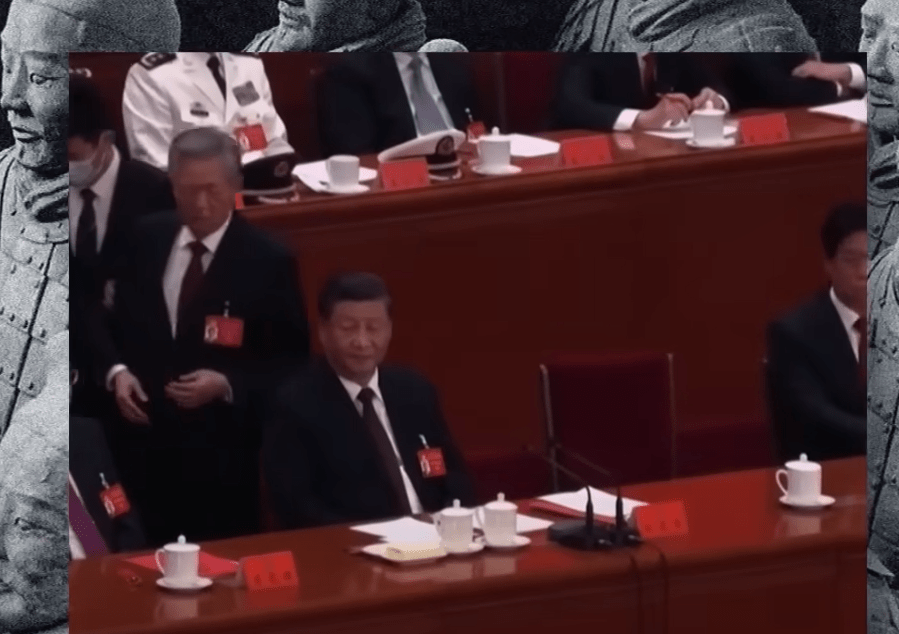
And it so transpires today that the stepping backwards has recurred in Chinese history: the purge of the “war against corruption” was simply a blow against all factions which had emerged including the princelings and even the army. All six China’s major cities have already been brought under the control of Xi Jinping’s protegees who the Observer Research Foundation has already dubbed as The Xi-Gang. This has resulted in the destruction of the Collective Leadership Principle, which was a product of China’s opening in 1976, and the recurrence again of the “one man only” authority. And during COVID, we also saw a great hint of that seclusive cultural tendency, which scared Westerners and Western investments. There is nothing surprising if one knows a little bit of history, for the recurrent forces of the underlying governing dynamics are not illusory abstract creations like ideologies (as liberalism / free choice / communist society etc.), but rather governing tendencies inscribed in vital and existential modes due to manifest and bring about concrete actions and reactions.
3. Asserting Themselves
The world must stand still and wait until China catches up. It must fall if China falls. That juncture represents having already full control, for to wait for China means to fall into their control. And because it is not convenient that China falls or lags behind, the world must …………………………………”gravitate around China”. THE MIDDLE KINGDOM SYNDROME.
At this height, it should be clear to the meanest intelligence that said inwardly looking forces impelled by such governing dynamics in dealing with Others, combined with the immense shame of the fact that everything that constitutes Modern China is an adaptation of the Western ways means that the only way by which China can assert themselves nowadays is not only through economic figures, which are already fake, bent or partially used to convince people that they are atop everyone; but also through the implied and inevitable modification of the intellectual apparatus/academia/world’s knowledge, etc. in order to dominate such seclusive, inwardly looking force which existentially needs the sameness of its own ways.
It is not that the West will have to be the object of China’s projections and inversion of narratives (well deserved); but that the entire world vision of things and history will have to be radically bent (as it is their habit), for that it is indeed the embedded aim in all this existential force.Geopolitically speaking, the fact of the matter is that the world does not need another United States and even less a cheap imitation of it; for this would need a deeper bending of the facts and realities, not only reduced to political and economic aspects, but conceivably, a new apparatus of epistemological, historical and even methodological knowledge, as China existentially needs a Chinese reality to assimilate the world. That ultimately means: to make the entire world understandable for China; and not China adapting, adding or contributing to what other cultures have already set in a collective effort. Impossible, as it has never happened in three thousand years of Chinese history, and it is the reason why seclusion is an intrinsic existential, core tendency of China in the world. And it implies that what China needs is an entire world with Chinese characteristics in order for China to share with the world whilst cowardly hiding behind Western deeds of colonialism. And while even the Catholics adapted their set of beliefs and imageries to local realities, as seen in the diversity of black Jesus and Madonnas round the world, China needs to make other realities Chinese or with Chinese characteristics, in order not to know something different but to make it recognizable. And just then they are able to share with others. But at that point, by cultural impulse, everything is inserted in a hierarchical world vision: a Confucian vision by which they need to see the world in a vertical way (including racial), and what often has historically resulted in that long millennium practice of bullying neighbours or appropriating heritage by some sacred ancestral right. Not even as the West did (which already has been destructive enough): through techniques of assimilation of the natives, customary laws mimicking local traditions or other ways of “not alienating the local”, but in the Chinese case through direct imposition of their scheme and vision; whilst cowardly covering behind Western colonial deeds. Here it brings us back to the first sentence of this paragraph: the world does not need another USA, and even less a cheap imitation of it.
P.S. But the west has not choice now; in fact, the west created the current China and so they are both responsible and, as how the times are now, victims of their own creation. Everything seems to be in order then.


 Hado
Hado 
Leave a comment